Kinnaur’s First Bird Book: A Story Rooted in Nature, Memory & Community
The idea for Kinnaur’s first Bird Book didn’t begin as a book at all. In my early days of taking nature sessions in schools, my only intention was to spark curiosity among students and help them notice the world they were already living in. But during these sessions, I realised something important: the children were eager, yet they had almost nothing they could turn to that reflected their own surroundings. Kinnaur is a place of remarkable richness, mountains, deep valleys, seasons, and a biodiversity that is unlike anywhere else yet there was no simple, localised material that told these stories. Nothing that helped them understand the land they walk on every day. That absence slowly became the starting point of this journey.
Over time, I realised something important: Students were eager, but the learning material wasn’t rooted in their own land. And many of the stories, names, and ecological wisdom carried by elders are slowly fading as native languages become less commonly used. Though our nature aan
This led to one simple but powerful question: What if Kinnaur had its own bird book—created from within the landscape itself?
That question became the foundation of the Kinnaur Bird Book Project, an initiative under Aum Kinnaur, in collaboration with Zed.Tells, and supported by the Royal Enfield Green Hub Initiative (Western Himalayas).
How the Project Started
From Walks, Conversations & Curiosity
This project didn’t begin as “a book project.” It began with:
- walking with students
- asking small questions
- listening to elders
- travelling across valleys
- learning from everyday interactions with the land
As I spoke to more elders and walked with more youth groups, something unexpected happened: I realised how much I myself didn’t know about the land I grew up in.
This Bird Book is not only for others. It is also my way of understanding my own landscape, my home.
Local Names, Living Knowledge
One of the most beautiful discoveries was how a single bird could have multiple names across different villages and how each name carries deep meaning.
From my Aapi (grandmother) I learned about birds like Koyan (Yellow-billed Chough) and take Pompya our local name for the Plain Mountain Finch.
In high altitudes, these finches stay far away. But as winter approaches, hundreds of them descend into the villages. Their arrival signals the coming of snow.
That’s why people call them:
Pom = Snow
Pya = Bird
These small understandings made me realise: This book cannot be just a catalog of species. It must hold culture, memory, ecology, language—and people—together.
Where the Project Stands Today
With support from Aum Kinnaur, Zed.Tells, local youth, and the larger community, we have been able to:
- organise bird walks across villages
- document culturally rooted bird names
- record elders’ stories and memories
- collect ecological notes on behaviour and migration
The book is still in progress, growing slowly and meaningfully just like the landscape itself.
This Book to Belong to the Community
We would love to hear from you.
This Bird Book is a collective effort to preserve memories and pass them forward to the next generation.
Every name, every story, every detail helps us understand Kinnaur better, not just scientifically but culturally and emotionally.
Your contribution can become a part of this book.
How to Contribute
📩 To share stories, names, or knowledge, you can write to us. We welcome contributions from elders, youth, students, travellers, researchers and anyone who loves Kinnaur and its natural heritage.
Together, we can make Kinnaur’s first Bird Book truly belong to the people who call these mountains home
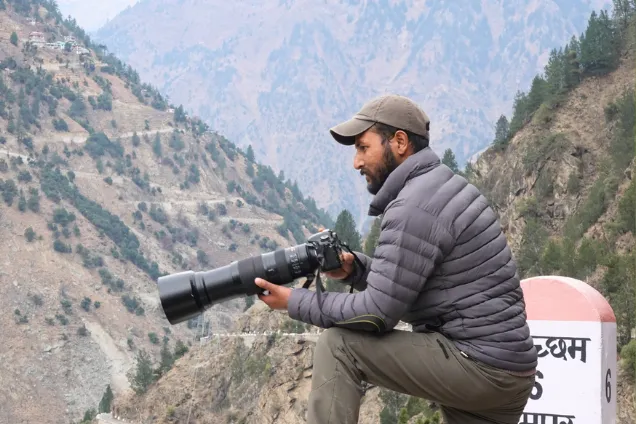
About the Author
Mahesh Ronseru is a mountain photographer from Kinnaur who loves light and storytelling.